
How to Install and Configure Jotform in MonkeyPod
MonkeyPod integrates with Jotform to bring information from your web forms right into your MonkeyPod! Interested in what Jotform can do for you? Check out our Jotform Overview.
Jotform is an advanced integration, so it is included with Enterprise level subscriptions and available for a fee to Pro and Essentials subscribers. Learn more about MonkeyPod premium apps and integrations!
How do I install Jotform in my MonkeyPod?
First, you'll need to make sure that you have a Jotform account. Don't have an account yet? Check out Jotform.com to sign up for one before you continue.
Next, install the Jotform integration in your MonkeyPod: Choose Apps & Integrations > Integration from the main menu. Find the Jotform App and click the "More info or install" link.

The next page displays details about the Jotform integration. Click the "Install" button to install Jotform.
The "Install" button then changes to "Manage / Update Settings". Click it to continue with the instructions below to configure those settings for your MonkeyPod.

MonkeyPod prompts you for your Jotform API Key. This allows your MonkeyPod to connect with your Jotform and use the form data. Locate your API key through your account at Jotform.com, and paste it into the field here.

Notes on Jotform API access: At the time of writing, the API key can be found in Jotform under the user Settings in the API section. When setting up your API key in Jotform be sure to grant "Full Access" if you want MonkeyPod to automatically process submissions from Jotform.

MonkeyPod needs "Full Access" for the initial setup because it has to be able to create webhooks. Webhooks are used by Jotform to notify MonkeyPod when a submission comes in, and creating one requires write permissions. Once you have your Jotform integration installed and configured in your MonkeyPod, only "Read Access" is necessary. MonkeyPod does not write to or edit the submissions in your Jotform.
Your installation is now complete! Jotform will appear in your Apps & Integrations menu under My Apps & Integrations.
How do I configure my Jotforms in my MonkeyPod?
Once you have installed and configured the app, all of your Jotforms are listed in your MonkeyPod. You'll find them under Jotform in the Apps & Integrations menu (under My Apps & Integrations).
To configure how MonkeyPod handles submissions from a form, select the gear icon for the form you're working on.

There are two parts to the Jotform submission handling setup: Form Submission Handling and Question Configuration.
Form Submission Handling
In the "Submission Handling" section, configure how MonkeyPod should handle submissions received by that form.
NOTE: The first few options are contingent upon getting a MonkeyPod name or email field correctly mapped to the related Jotform questions in the "Question Configuration" section described below. The options and status alerts will change once your configuration is complete and accurate.
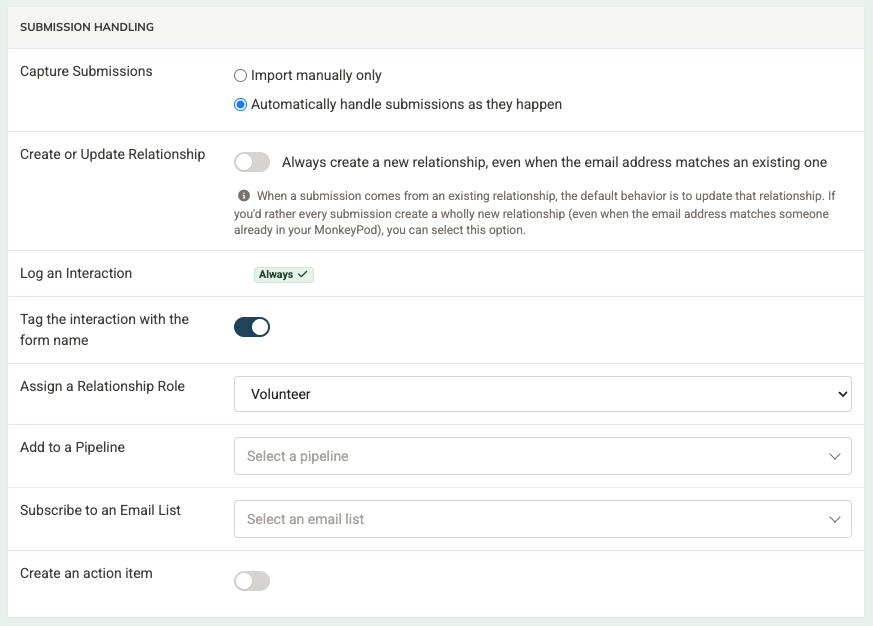
- Capture Submissions: Most MonkeyPod users choose to have their Jotform submissions automatically processed and added to their MonkeyPod relationships—but you also have the choice to manually review them first and import each one. Choose the option that works for you! See the following section for more detail about processing submissions.
- Create or Update Relationship: By default, once you have a MonkeyPod email field correctly mapped to the related Jotform questions (see "Question Configuration" below), MonkeyPod updates any existing relationship record with the new data from a matching Jotform submission. Turn on this toggle if you'd rather MonkeyPod never update an existing record from this form. Every submission will create a brand-new relationship instead. This toggle only appears once you've mapped a question to Email Address. (This option is useful when several people share one email address. For example, if a parent registers three kids for your summer reading camp using the parent's own email, each registration would be recorded on the parent’s relationship—making the kids' names aliases, and overwriting other existing data. With the toggle on, each child gets their own relationship.)
- Log an Interaction: If MonkeyPod's name or email fields are correctly mapped to related Jotform questions, MonkeyPod will automatically log an interaction for the matching relationship records. The status of this functionality is shown here.
- Tag the interaction with the form name: Turn on this toggle to tag the interaction logged for each Jotform submission with the form name. This makes it easy to find these interactions later in the Interactions Feed, or clearly identify their source when viewing a relationship's interactions.
- Assign a Relationship Role: Choose a role here if you'd like to assign a role to the relationship record for the person who submitted the form. For example, if you're configuring a form for volunteer interest, you might want to assign the "Volunteer" role to all related relationships.
- Add to a Pipeline: When someone fills out this form your MonkeyPod can automatically add them to a pipeline. Just select the relevant pipeline from the list.
- Subscribe to an Email List: Select an email list here to automatically subscribe someone to the list when they submit a form response.
- Create an Action Item: If someone in your organization should be assigned a task whenever someone submits a form response, turn on this toggle to create an action item when a submission comes in. You'll then have the option to enter a title for the action item and an assignee.
Question Configuration
In the "Questions" section, match the questions on your form to fields in your MonkeyPod. This is how MonkeyPod knows where to store the information from the Jotform submissions.
On the left is the Jotform field. Choose the MonkeyPod relationship field that it corresponds to from the drop down menu on the right.
To create a new relationship from a Jotform submission, you must include either a last name (or full name) or an email address. Without those fields mapped here, MonkeyPod won't be able to process the Jotform submission.

Important Points about Matching Jotform Submissions with Existing MonkeyPod Relationships
An email address is required to match a Jotform submission to an existing relationship in your MonkeyPod.
When a Jotform submission matches an existing relationship:
- Full Name: The newly submitted name, if different from the original, is added as an alias for the matching relationship. The existing name will not be modified.
- Full Address: The address from the new submission will be stored as a secondary address in the relationship. The existing address will not be modified.
- Phone: New phone numbers are added to the relationship, along with the existing one(s).
- Custom Attributes: If the custom attribute type allows for multiple values (like tags or checkboxes), then new Jotform data will be added, otherwise for text fields or other types where only one input is allowed, the new Jotform data will replace the existing data.
If you don't want your MonkeyPod data updated with the Jotform input, then do not map the question to a relationship field in MonkeyPod's Jotform configuration.
How are submissions processed?
As you saw in the Submission Handling settings described above, you can choose to manually import Jotform submissions, or have them automatically entered.
If your submissions are set to be automatically entered, the new information is written directly to your MonkeyPod and new interactions are logged as submissions come into Jotform. It doesn't require any effort on your part.
If you choose to manually process the Jotform submissions, all new submissions will essentially be in a holding pen waiting to be reviewed and processed. As submissions come in, you can choose the "Forms" tab in the Jotform integration to see the number of submissions received for your form. Click that number to review the individual submissions.

Each submission is displayed in the list with the submitted details. To add a submission to your MonkeyPod, click the "Process Submission" icon at the start of the row and MonkeyPod will create or update the matching relationship and record the interaction for that relationship.

Once a submission has been processed and added to your MonkeyPod, it remains in the submissions list but shows that it has been processed.

Frequently Asked Questions
Is there a way for me to view my Jotform from MonkeyPod?
Yes! When viewing your Jotforms list in MonkeyPod (Apps & Integrations > "My Apps & Integrations" > Jotform), click the "view form" icon associated with the Jotform of interest to display your form.

Is there a way for me to easily copy the link for the form from my MonkeyPod?
Yes! Click the "Copy URL" icon to copy the link to that Jotform.

Yes, with one important exception. After you set up a form's handling rules in MonkeyPod, you shouldn't change the "Unique Name" for any of the fields in Jotform. (This is an advanced feature that most users don't ever encounter, but just in case...) MonkeyPod uses that internally to track how the field should be handled, so if you change it your configuration will break.
Pretty important! The email address is the only way we have to identify when the person submitting the form is an existing relationship in your MonkeyPod (vs. a new one that should be added). So it's not strictly required, but it's highly recommended.
MonkeyPod updates the existing relationship. A different name is saved as an alias, and new addresses and phone numbers are added alongside the existing ones. Single-value custom attributes (like text fields) are replaced with the newest response, while multi-value ones (like checkboxes and tags) are added to. Other fields are overwritten with the new submission data.
If you've turned on Always create a new relationship, even when the email address matches an existing one for that form, each submission creates a separate relationship instead, so the same person submitting twice will end up with two relationships. You can combine them using the steps in How to Clean Up Duplicate Relationships.
What if several people share one email address?
This comes up a lot with families, like a parent signing up their kids for a program, or a couple who share an email registering separately. Since MonkeyPod matches submissions by email address, each new submission would land on the same relationship: everyone’s names would be recorded as aliases, and single-value fields would get overwritten by the latest submission.
To keep everyone separate, open the form's settings and turn on the Create or Update Relationship setting to always create a new relationship, even when the email address matches an existing one. It's set separately for each form. Once everyone has their own record, you can link them together with householding. With this toggle on, MonkeyPod won't recognize returning submitters either, so you may see more duplicates to merge from that form.